
A river city with a registry of heritage and landmark trees
Tree Removal in Petaluma, CA
Permit-aware removals from the west side Victorians to the east side tracts.
- We price jobs standing in your yard, anywhere in Santa Rosa and central Sonoma County
- Written estimate with each job priced separately
- Chips, logs and brush plan made at the estimate
Three Kinds of Protected Trees
Tree Removal in Petaluma can require a city permit even when the tree is entirely on private land. The Planning Division may require a tree removal permit when a tree is protected under Chapter 17 of the Implementing Zoning Ordinance. Protected trees fall into three groups: certain native species, trees designated as heritage trees, and trees that were protected as a condition of a development approval. That third group surprises people. If your subdivision was approved with specific oaks to be preserved, those trees may carry protection that you never heard about when you bought the house.
The heritage tree registry
Petaluma also has a Heritage Tree Ordinance, and owners can nominate trees for the City Tree Registry, which protects them from removal. The city keeps an online Register of Heritage and Landmark Trees, and a Tree Advisory Committee advises on tree issues. If you are buying or selling a home with a very large or old tree, it is worth checking the register.
Street trees need an encroachment permit
Trimming or removing a tree in the public right-of-way, usually the planter strip between the curb and the sidewalk, requires an Encroachment Permit. Some street trees are protected and need staff review first. Property owners are also responsible for keeping up the sidewalk and street planters in front of their homes, which is why so many root-and-sidewalk problems end up as the owner's project. The city's Building and Planning counter at 11 English Street is the place to start.
West side and east side are different jobs
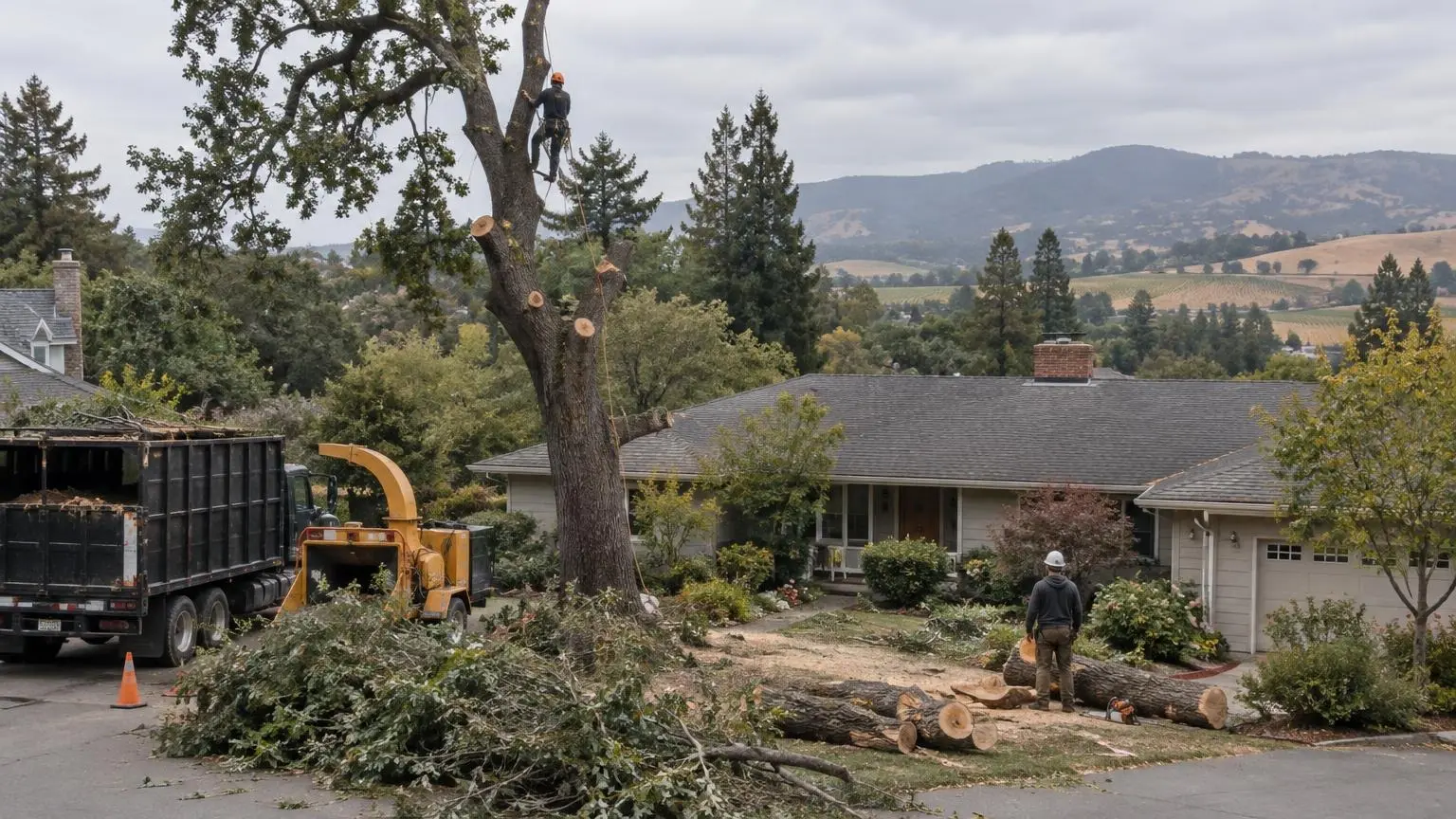
The city was relatively unharmed in the 1906 earthquake, and pre-1906 buildings and Victorian homes still stand on the west side of the river. Those older lots often have large, old trees, sometimes planted a century ago, crowding houses, garages and overhead lines. Removals there are slow, careful, piece-by-piece work. East of the river, newer tracts have younger trees but smaller yards and shared fences. Many of the requests there are for fast-growing species that were planted too close to a house.
Living in a floodplain
Petaluma sits at the head of navigation on the Petaluma River, a tidal estuary, and a significant part of the city lies in its floodplain. The river overflows every few years, notably in the Payran neighborhood. Trees in repeatedly saturated soil lose root strength, and after floods we see more leaning and uprooted trees. The heaviest storms also bring south winds against soaked ground.
Heat, fog and sudden oak death
Summer mornings are often foggy and cool, but the city also recorded 111 degrees on September 6, 2020. Drought and heat stress add up in shallow-rooted trees. The 2019 sudden oak death survey also found an outbreak in southwestern Petaluma, where coast live oaks and bays grow together on the hills toward Helen Putnam Regional Park.
Getting an estimate
Call (707) 385-5238 or use the form. We will tell you if your tree may be protected, flag any right-of-way issue and give you a written, itemized estimate. Get a free estimate
Petaluma Facts
- Protected trees. Under Chapter 17 of the Implementing Zoning Ordinance, protected trees include certain native species, designated heritage trees and trees protected as a condition of a development approval.
- Street trees. Trimming or removing a tree in the public right-of-way requires an Encroachment Permit, and some street trees need staff review; owners maintain sidewalks and planters in front of their property.
- Floodplain. A significant amount of the city lies in the Petaluma River's floodplain, and the river overflows every few years, especially in the Payran neighborhood.
- Older west side. Petaluma was relatively unharmed in the 1906 earthquake, and pre-1906 buildings and Victorian homes remain on the west side of the river.
- Housing and SOD. QuickFacts lists a 64.5% owner-occupied rate and $878,600 median value; the 2019 SOD Blitz found an outbreak in southwestern Petaluma.
Petaluma Questions
How do I find out if my Petaluma tree is a heritage tree?
Check the city's online Register of Heritage and Landmark Trees, or ask at the Building and Planning counter at 11 English Street. Heritage trees on the registry are protected from removal.
Do I need a permit to trim the tree in my planter strip?
Yes. Trimming or removing a tree in the public right-of-way requires an Encroachment Permit, and some street trees need staff review first.
Could my tree be protected because of how my subdivision was approved?
Possibly. Petaluma protects trees that were preserved as a condition of a development approval. If your neighborhood was built around existing oaks, ask the Planning Division before removing one.
Who takes yard waste in Petaluma?
Recology Sonoma Marin is the city's franchised hauler. Tree removal debris is too much for curbside carts, so chipping and hauling are included on our estimates.
Free Estimates in Petaluma, CA
Free estimates on both sides of the Petaluma River.
Tree Removal Near Petaluma
- Tree Removal in Santa Rosa, CA
- Tree Removal in Roseland, CA
- Tree Removal in Fulton, CA
- Tree Removal in Larkfield-Wikiup, CA
- Tree Removal in Rohnert Park, CA
- Tree Removal in Cotati, CA
- Tree Removal in Windsor, CA
- Tree Removal in Healdsburg, CA
- Tree Removal in Geyserville, CA
- Tree Removal in Sebastopol, CA
- Tree Removal in Graton, CA
- Tree Removal in Forestville, CA
- Tree Removal in Penngrove, CA
- Tree Removal in Sonoma, CA
- Tree Removal in El Verano, CA
- Tree Removal in Boyes Hot Springs, CA
- Tree Removal in Fetters Hot Springs-Agua Caliente, CA
- Tree Removal in Kenwood, CA
- Tree Removal in Glen Ellen, CA
- Tree Removal in Guerneville, CA
- Tree Removal in Monte Rio, CA
- Tree Removal in Occidental, CA
- Tree Removal in Bodega Bay, CA